Don't Wordle uses the familiar five-letter word grid, but turns the objective around. Instead of trying to find the hidden word, your goal is to avoid entering it.
Every guess still produces green, yellow, and grey feedback. The difference is that each clue becomes a rule for every later guess, so you must stay away from the answer while continuing to respect what the board has already taught you.
How to play Don't Wordle
Start with a valid five-letter word, or use the random starting-word option.
Before entering the next word, apply every constraint the board has created.
Choose the next word to keep as many valid words remaining as possible, without entering the hidden answer.
Use an UNDO carefully when a guess leaves too few valid words in play.
Every clue becomes a rule
A green tile means the letter must remain in that exact position in every future guess. A yellow tile means the letter must appear again, but in a different column. A grey tile removes that letter from every future guess. These constraints are why a word can be valid in a dictionary but still be invalid for the current Don't Wordle board.
The remaining-word count at the top is the key measure of safety. It shrinks after each guess. A high count gives you room to manoeuvre; a low count means you are at risk of accidentally entering the answer.
A real Don't Wordle loss: from 3,095 words to the answer
This run shows why the game is harder than simply choosing unusual words. The board began with a reasonable-looking opener, but each clue turned into a permanent restriction. By the final row, the hidden word was entered instead of avoided.
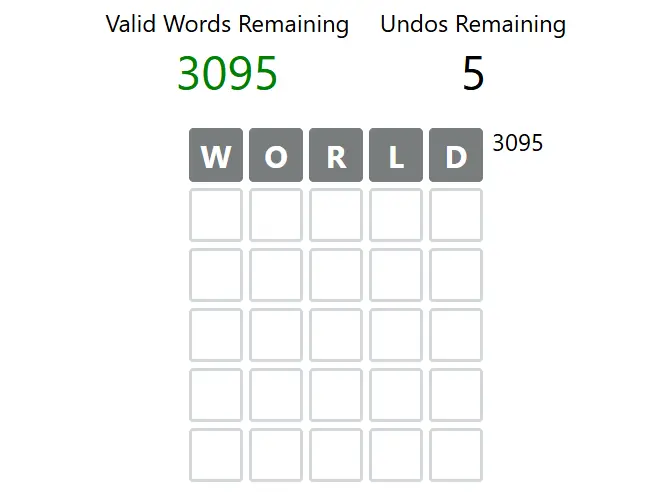
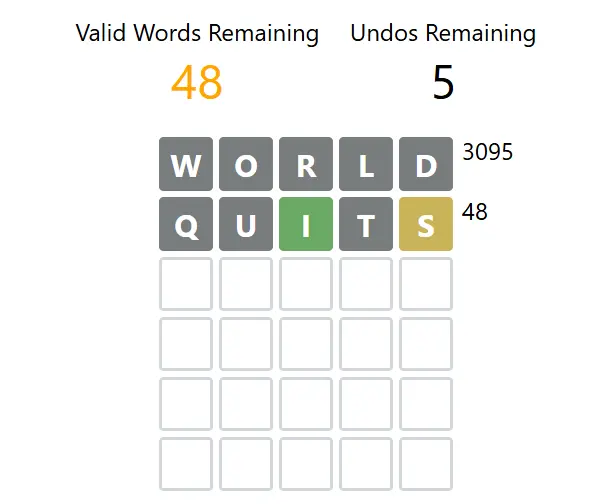
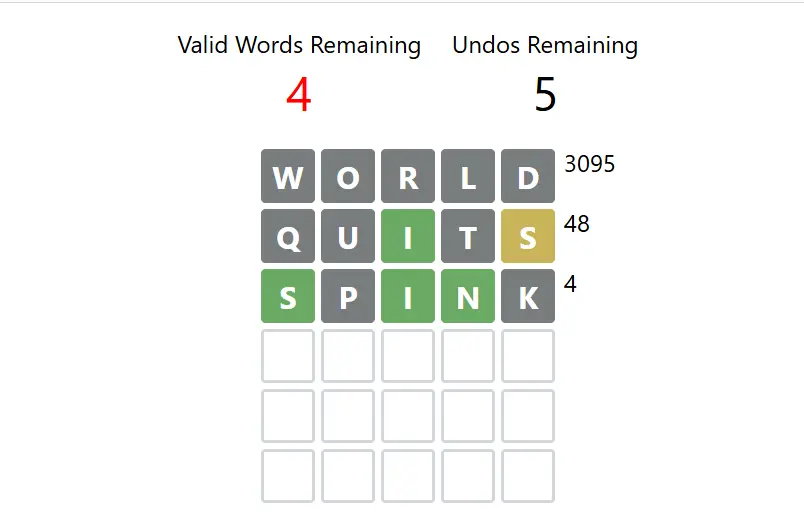
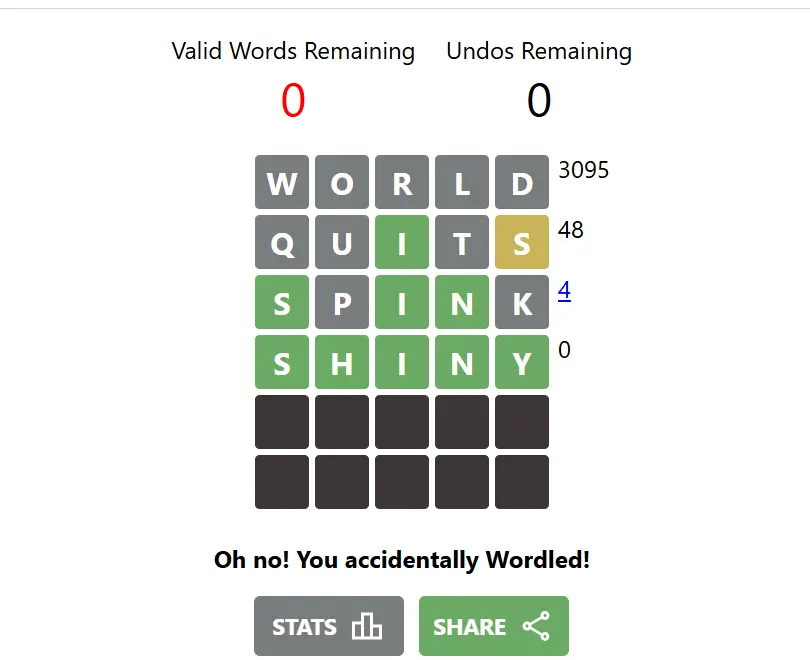
1. WORLD removes five common letters. All five tiles are grey, so W, O, R, L, and D can never be used again. The counter still shows 3,095 valid words, but the run is already committed to a much narrower vocabulary.2. QUITS makes the board much more specific. I is green in column three, so it must stay there. S is yellow, which means it must be used later but not in column five. Q, U, and T are now unavailable too, and the count falls from 3,095 to 48.3. SPINK leaves only four legal choices. This guess places S in column one, keeps I in column three, and fixes N in column four. P and K are grey. The pattern is now S _ I N _, while every earlier grey letter is still banned. A board with only four valid words gives almost no room to steer away from the answer.4. SHINY is the hidden word. Every tile turns green and the game ends with “Oh no! You accidentally Wordled!” The previous screenshot showed four candidates, so this was not proven to be the only possible move—but it shows the central risk: a word that perfectly satisfies every constraint may be exactly the word you must avoid. UNDOs cannot save a submitted answer.
Takeaway: a normal Wordle-style opener can be expensive here when its letters turn grey. Check the valid-word count after every guess, and use an UNDO before committing to a candidate that could be the answer—not after it has already ended the game.
More word games
Try Horsedle for a normal daily hidden-word challenge, Unwordle to rebuild a grid in reverse, or Wordhorse for a daily word ladder.
FAQ
Is a normal Wordle opening word a good start?
Not always. If several common letters turn grey, they are permanently banned and your future word choices become much less flexible. The WORLD example above shows this risk.
What happens if I enter the hidden answer?
The game ends immediately. An UNDO can help you reverse a risky earlier guess, but it cannot rescue a submitted answer.
What if the player does not load?
Use the fallback link shown by the player to continue directly on Don't Wordle.